Stories ·
Memento Mori Art: What It Means, Famous Examples and 9 Paintings to Hang at Home
What memento mori means in art, how it differs from vanitas, the most famous examples, and nine paintings with a story worth telling.
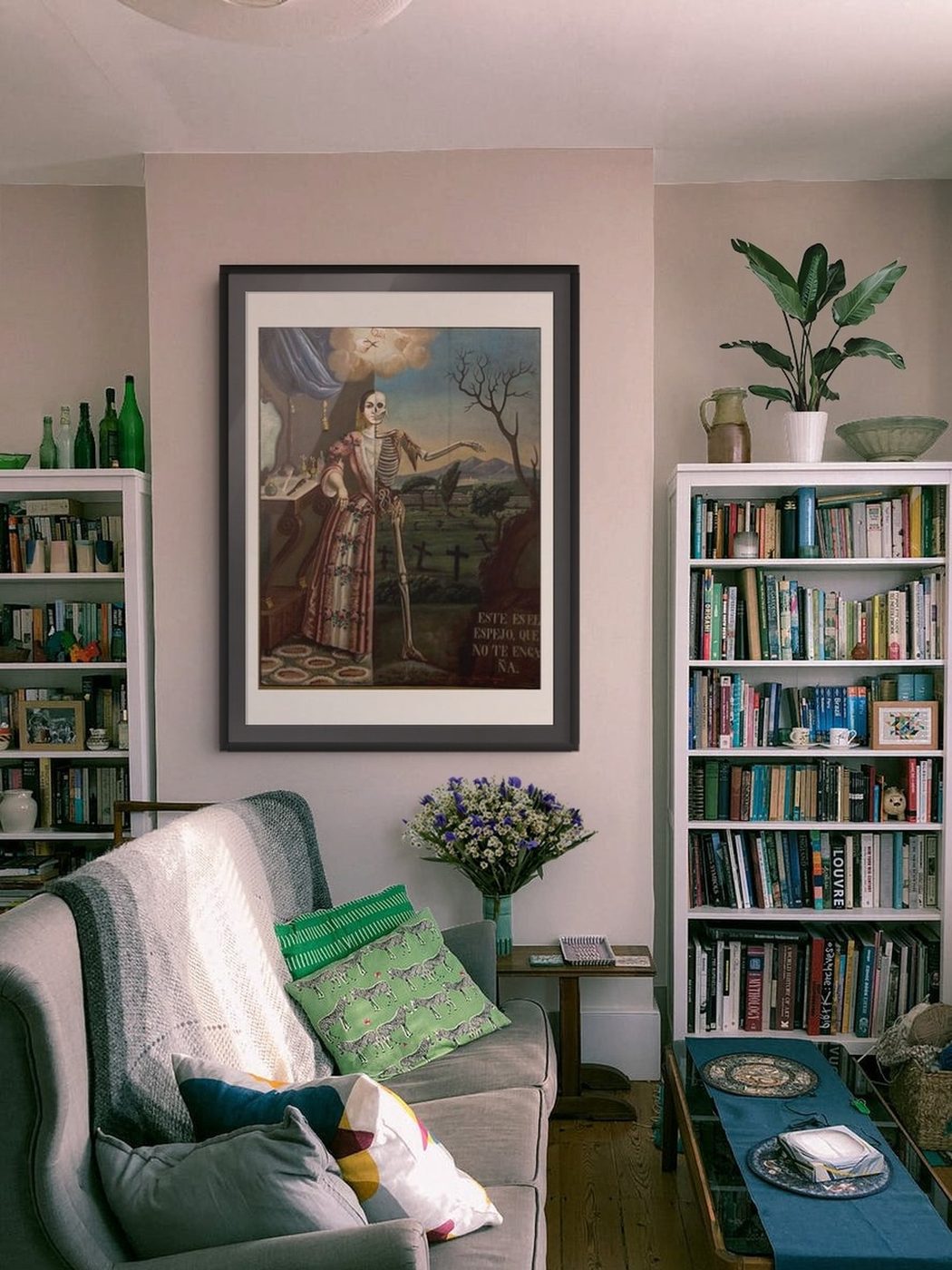
Memento mori art is any painting, carving or object made to remind you of death. The Latin phrase means “remember you must die”. Artists carry the message through a handful of symbols: a skull, a snuffed candle, an hourglass with the sand run through, a flower on the edge of wilting.
These pictures are not there to frighten you. They ask a quieter question. If your time is short, how will you spend it today?
Below you will find what memento mori means in art, how it differs from vanitas, the most famous examples, and nine memento mori paintings which are available at The Dark Academia Store as fine art reproductions, ready to ship framed or unframed.
What does memento mori mean in art?
In art, memento mori is a subject, not a style. A work counts when its purpose is to set your own mortality in front of you.
A portrait with a skull is the plainest version. Other common signs are clocks and hourglasses for passing time, guttering or extinguished candles for a life put out, and fruit and cut flowers, which spoil and wilt.
The idea is old. A story retold for centuries, and impossible to prove, says a Roman general riding in triumph kept a servant at his ear to remind him he was only a man. Medieval churches carved the idea onto tombs and painted the Dance of Death, where skeletons lead kings and peasants alike. By the 1600s, painters in the Netherlands had turned it into a genre of its own.
Memento mori vs vanitas: what is the difference?
Vanitas is one kind of memento mori. A vanitas is a still life of symbolic objects, painted to show how worldly goods and pleasures count for nothing beside the certainty of death. The name comes from the Latin Bible: “vanitas vanitatum”, vanity of vanities.
Memento mori is the wider idea. It covers portraits, allegories, sculpture, jewellery and gravestones. Every vanitas is a memento mori. Not every memento mori is a vanitas.
Famous examples of memento mori art
The most famous memento mori hangs in the National Gallery, London. In The Ambassadors (1533), Hans Holbein the Younger stretched a skull across the floor between two young diplomats. It only turns into a skull when you stand to the right of the painting and look back along it, a trick called anamorphosis.
A few rooms away, Harmen Steenwyck’s Still Life: An Allegory of the Vanities of Human Life (about 1640) sets a skull among books, a shell, a Japanese sword and a snuffed lamp, each a thing people spend their lives chasing. In Le Mans, at the Musée de Tessé, a Vanitas attributed to Philippe de Champaigne cuts the idea to three objects: a tulip for life, a skull for death, an hourglass for the time between.
Memento mori paintings to hang at home
Nine memento mori paintings and prints, from a 1620s still life to Van Gogh’s smoking skeleton, each with a story worth telling. Every one is available as a fine art print at The Dark Academia Store.
1. Memento Mori, “To This Favour” by William Michael Harnett (1879)
The skull in this painting is the punchline to a joke from Hamlet.
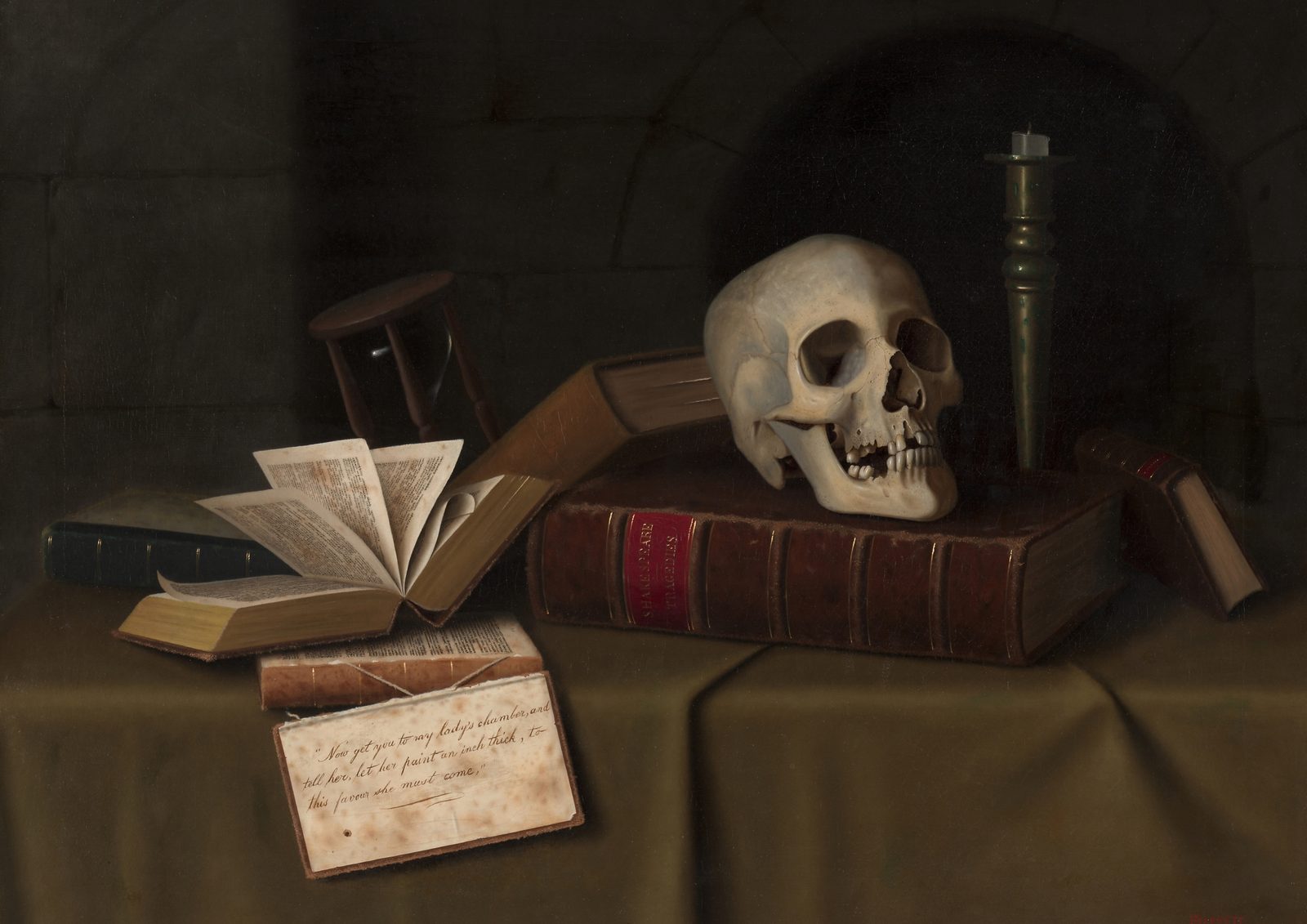
William Michael Harnett’s family left Ireland during the Great Famine and settled in the United States. He made his name with trompe l’oeil, still life painted so precisely it fools the eye.
Here a skull rests on a pile of worn books beside a burnt-out candle and an hourglass whose sand has run through. Inside a book cover, Harnett wrote out Hamlet’s words to the skull of Yorick: “Now get you to my lady’s chamber, and tell her, let her paint an inch thick, to this favour she must come.”
The Cleveland Museum of Art, where the original hangs, points out the pun. “Paint” means a lady’s make-up. It also means Harnett’s own oils. Both are illusions, and both end the same way.
Memento Mori, “To This Favour” is available as a fine art print at The Dark Academia Store.
2. Allegory of Death by Tomás Mondragón (1856)
One woman, split down the middle: silk on one side, bone on the other.
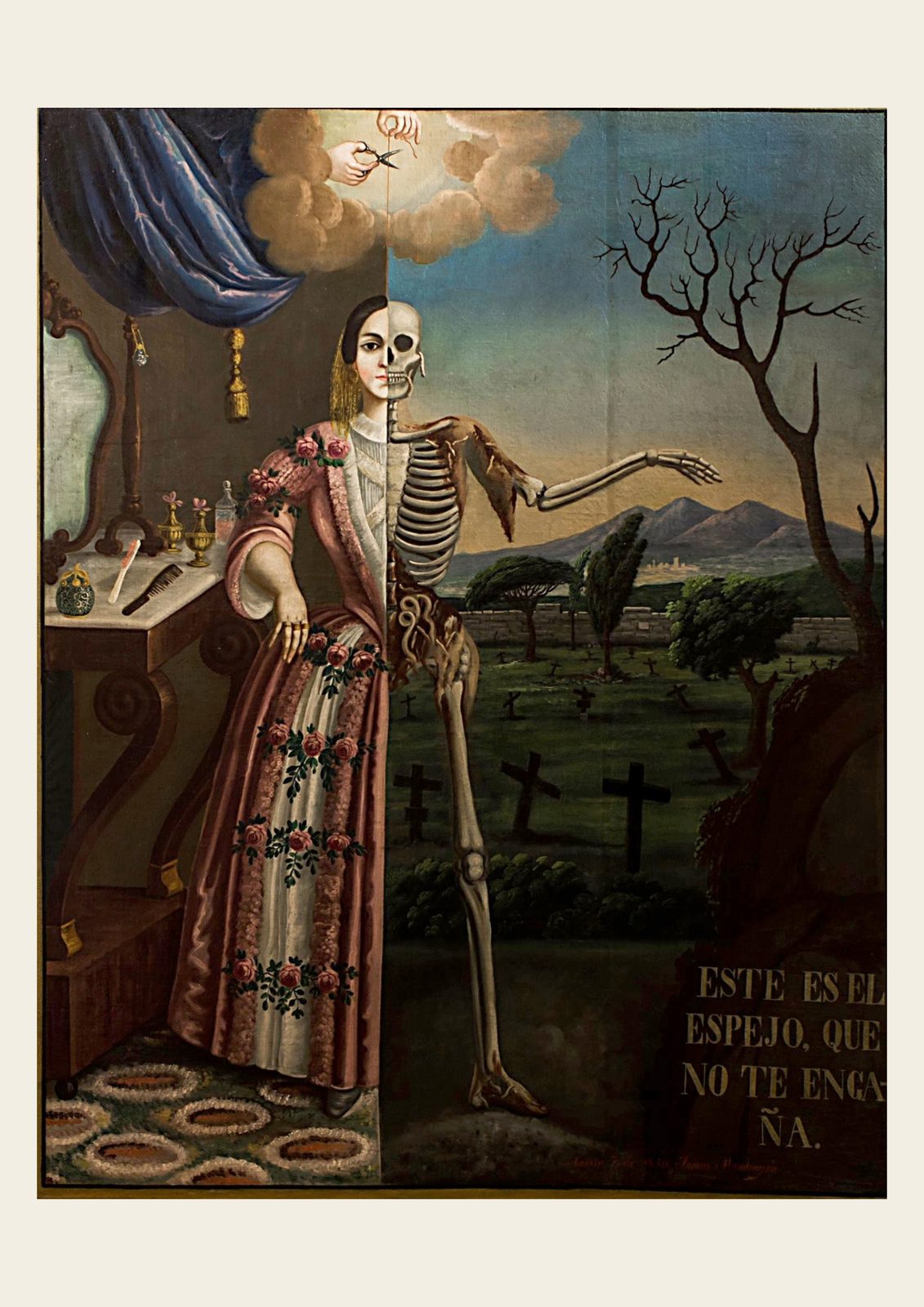
Tomás Mondragón painted this in Mexico in 1856. The canvas divides in two. On one side stands a richly dressed woman. On the other, the same figure appears as a skeleton. Its Spanish title is Este es el espejo que no te engaña, “This is the mirror which does not deceive you”. An ordinary mirror shows you the surface. This one shows what lies beneath.
The painting belongs to the Pinacoteca de la Profesa, the picture gallery of the church of San Felipe Neri in Mexico City. It arrived when many educated Mexicans were turning away from skulls, funerals and cemetery imagery. Historians read it as the Church’s way of carrying an old warning to the wealthy.
Allegory of Death is available as a fine art print at The Dark Academia Store.
3. The Race Track (Death on a Pale Horse) by Albert Pinkham Ryder (about 1896 to 1908)
Death rides alone, the wrong way round an empty track.
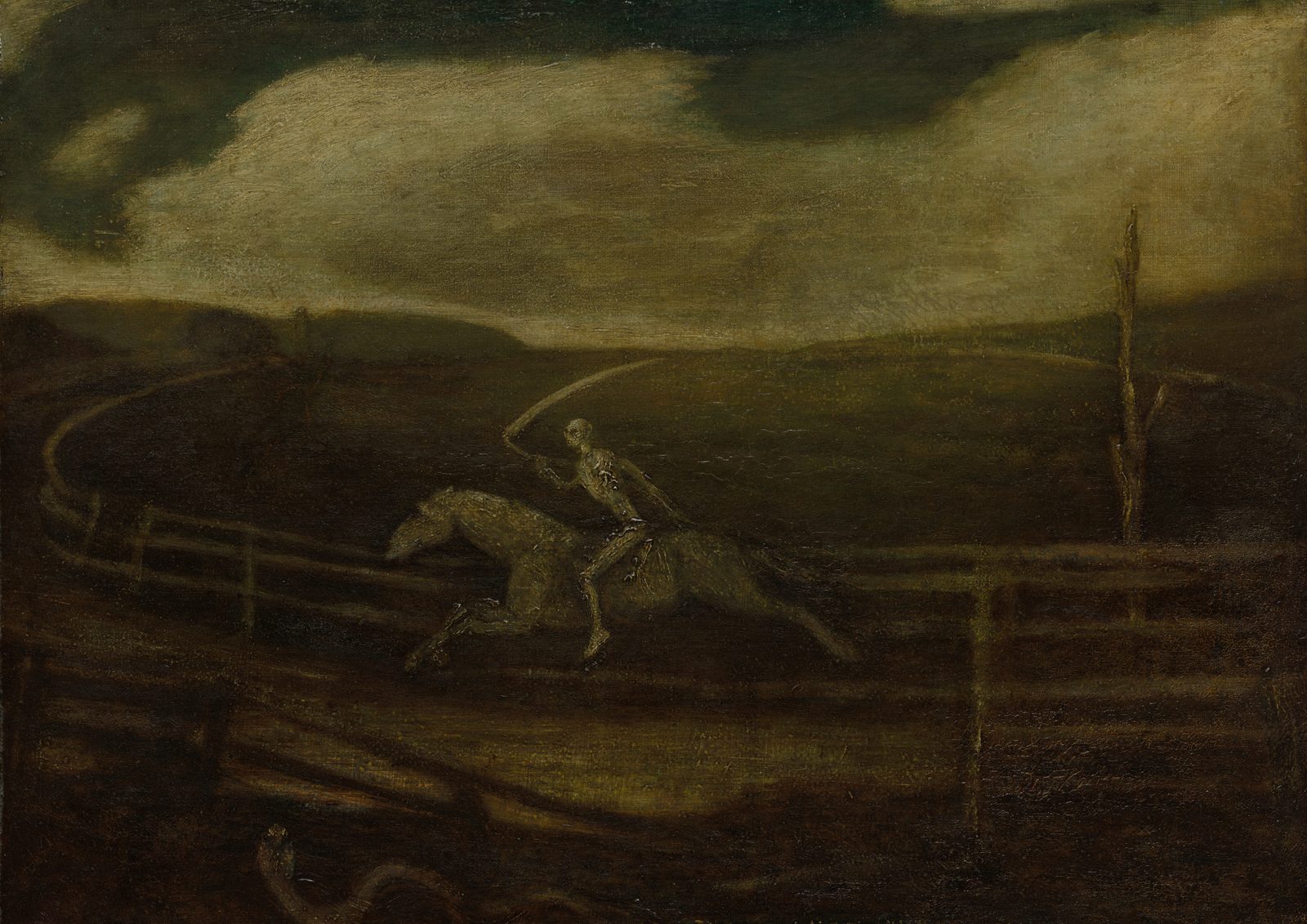
Albert Pinkham Ryder worked on this dark canvas for more than a decade. A skeleton with a scythe gallops a pale horse around a deserted racecourse under a heavy sky. A snake slides along the bottom edge. The subtitle comes from the Book of Revelation: “And I looked, and behold a pale horse: and his name that sat on him was Death.”
The story behind it is a real tragedy. In 1888, a friend of Ryder’s bet $500 on a horse race in New York. The horse lost, and the man took his own life.
Now look at the direction. The horse runs clockwise, the reverse of the usual way round the track.
The Race Track is available as a fine art print at The Dark Academia Store.
4. The Garden of Death by Hugo Simberg (1896)
In Hugo Simberg’s afterlife, Death is a gardener, and you are one of the flowers.
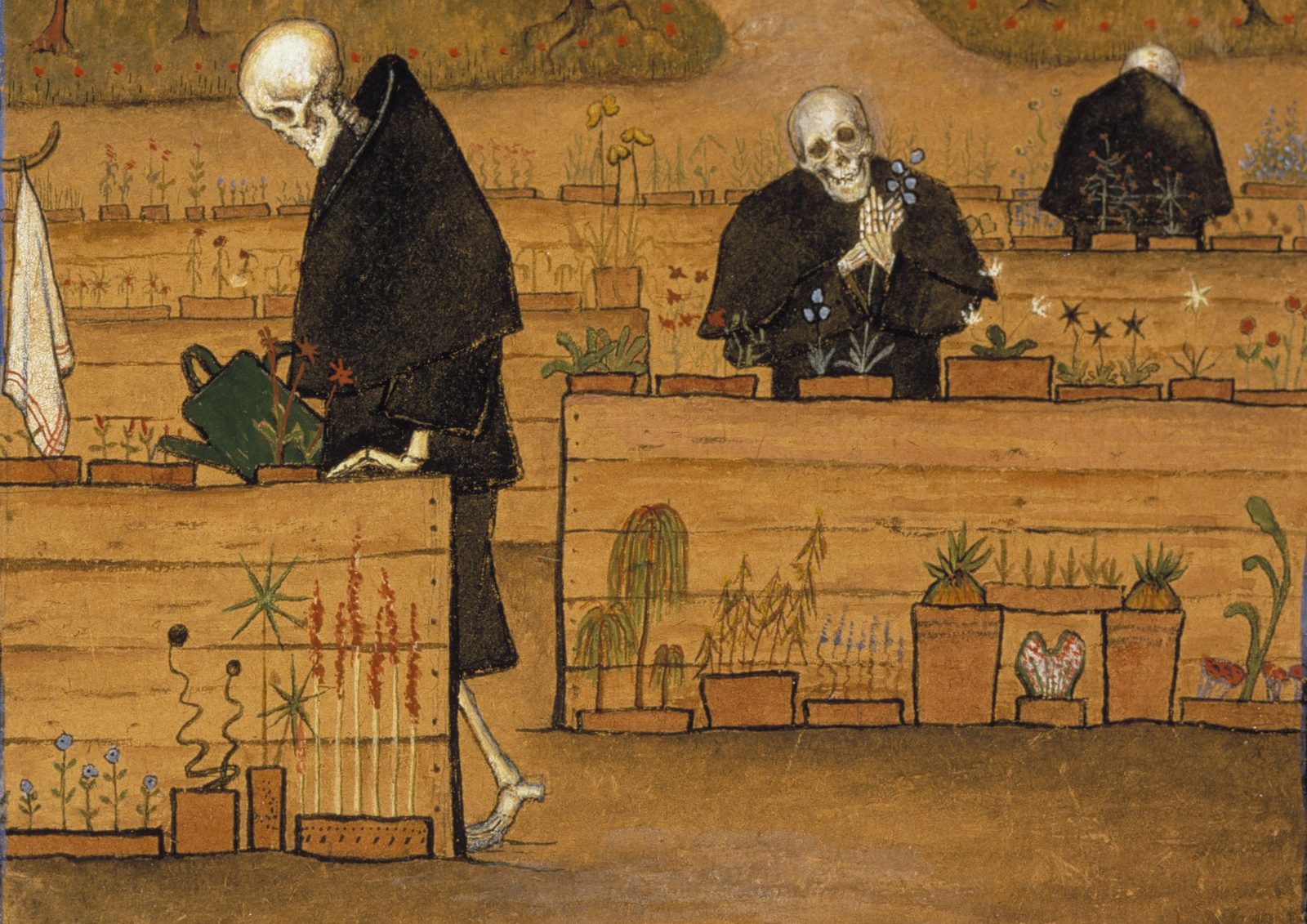
Three skeletons in dark robes water and tend rows of potted plants with the patience of old gardeners. Hugo Simberg, a Finnish Symbolist, seldom explained his pictures. He explained this one. The flowers are human souls. The skeletons are Death’s helpers. The garden is a waiting place before heaven.
The original is tiny, a watercolour and gouache about 16 by 17 centimetres, now in the Ateneum in Helsinki. Simberg returned to the idea years later and painted it again as a fresco in Tampere Cathedral, between 1904 and 1906. It is still there, near the altar.
The Garden of Death is available as a fine art print at The Dark Academia Store.
5. Head of a Skeleton with a Burning Cigarette by Vincent van Gogh (1886)
The most famous painter of sunflowers once gave a skeleton a cigarette.
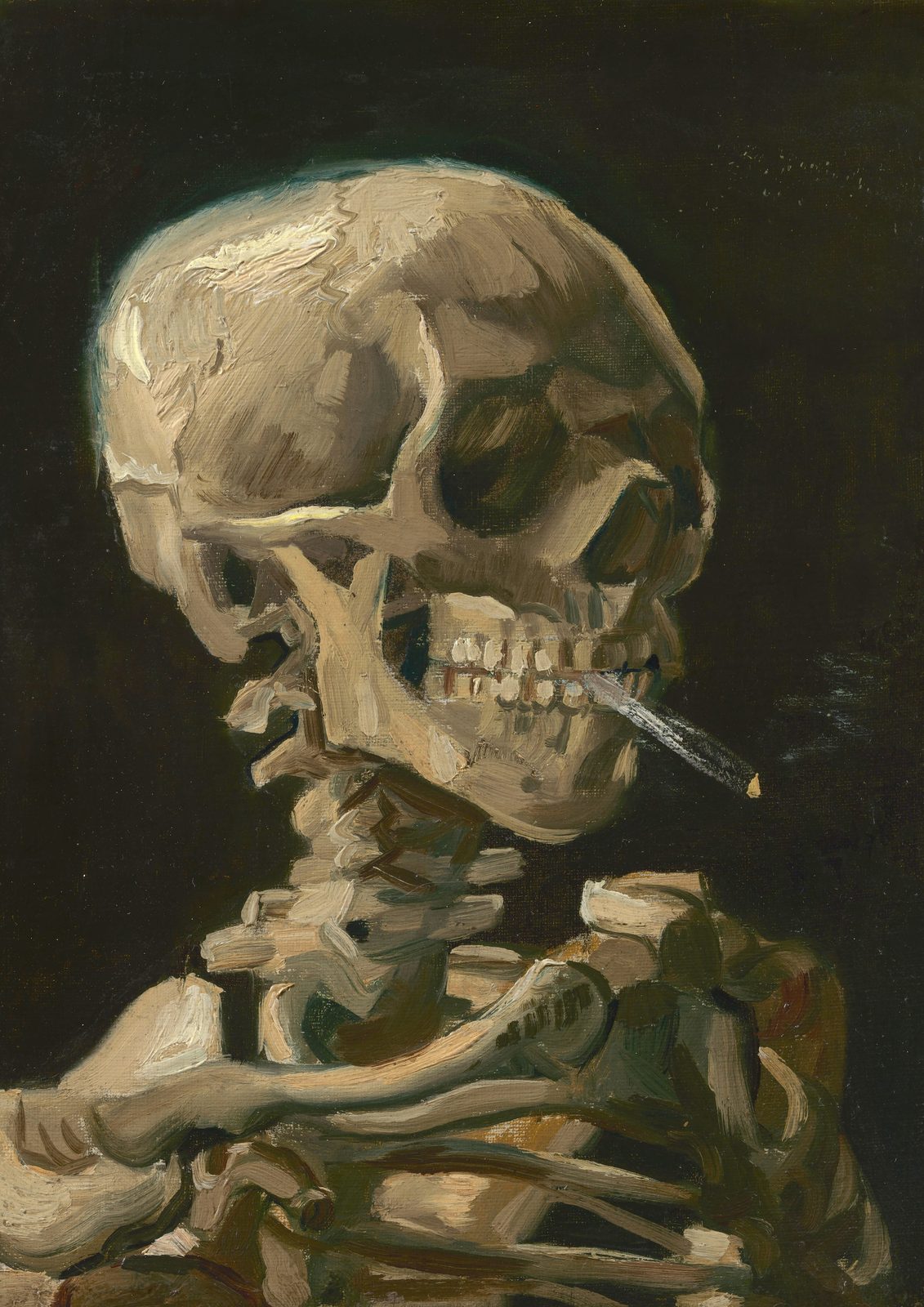
In early 1886 Vincent van Gogh was a student at the art academy in Antwerp. Drawing skeletons was a standard exercise there. Painting them was not part of the lessons, so he most likely made this small canvas in his own time, between or after classes.
The skull grins in profile, the cigarette lit between its teeth. The Van Gogh Museum in Amsterdam, which holds the original, calls it a juvenile joke. It also shows how well the young painter already knew his anatomy. Joke or not, it belongs to the oldest tradition here: a smoker’s pleasure, held in the mouth of death.
Head of a Skeleton with a Burning Cigarette is available as a fine art print at The Dark Academia Store.
6. Death and Life Contrasted, after Robert Dighton (1784)
Half a gentleman, half a skeleton, and a tombstone with his verdict already carved.
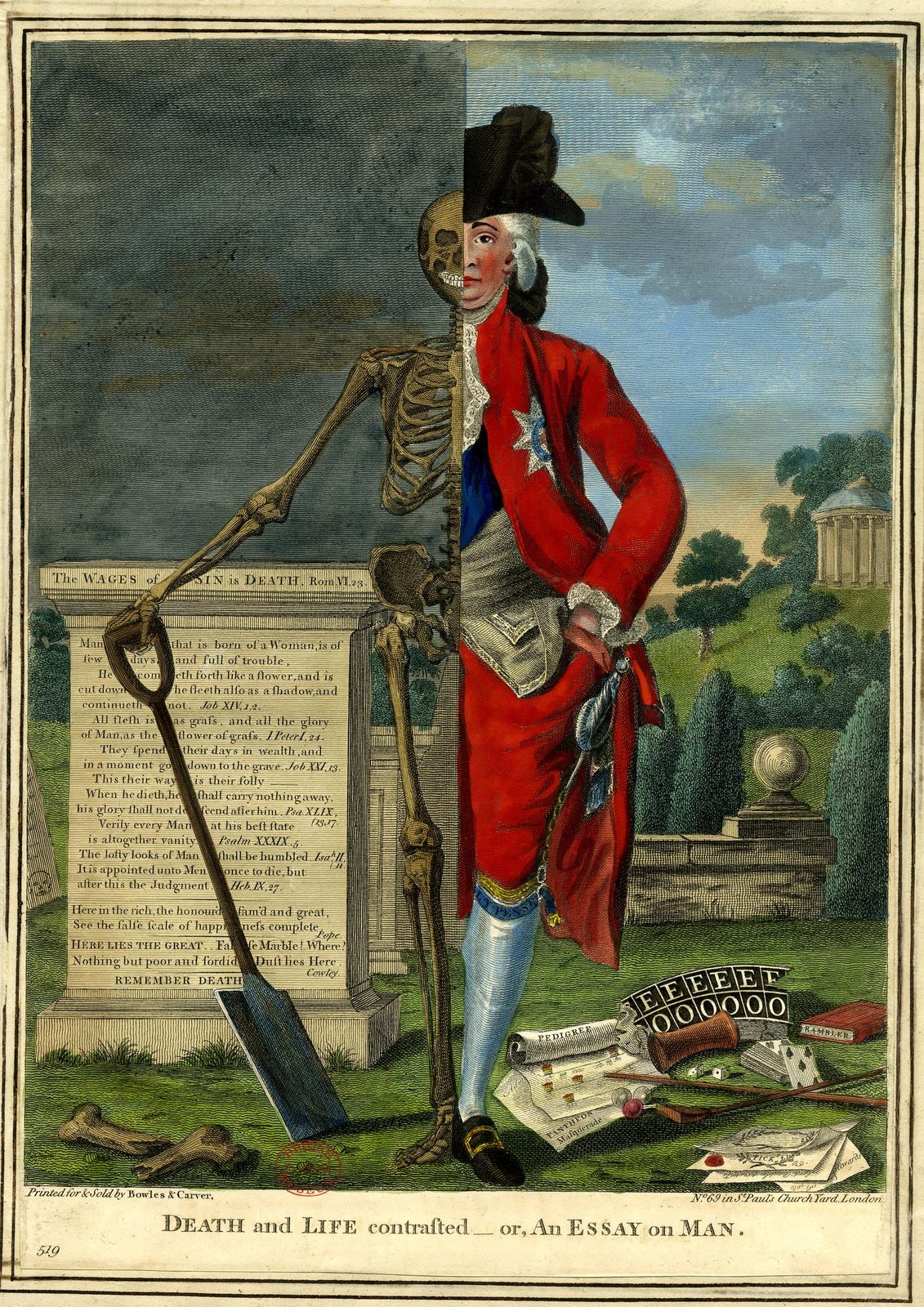
Robert Dighton the Elder designed this Georgian print as a satire on fast living. It was published in 1784 and reissued after 1793 by Bowles and Carver in London. Its full title is Death and Life Contrasted, or, An Essay on Man.
On the right stands a fashionable aristocrat in a landscaped park. Around his buckled shoe lie dice, playing cards, part of a roulette-style wheel and a masquerade ticket for the Pantheon in London. A scroll marked “Pedigree” shows his rank will not save him. On the left, his skeleton leans on a spade before a tombstone carved with Romans 6:23: “The wages of sin is death.” A companion print, Life and Death Contrasted, or, An Essay on Woman, makes the same point about a lady of fashion. The Metropolitan Museum of Art in New York holds an impression of the Man.
Hang it beside Mondragón’s Allegory of Death and you have two centuries and two continents telling the same truth.
Death and Life Contrasted is available as a fine art print at The Dark Academia Store.
7. Vanitas Still Life with a Skeleton by Carstian Luyckx (about 1655)
Every earthly prize in one room, and Death has pulled up a chair.
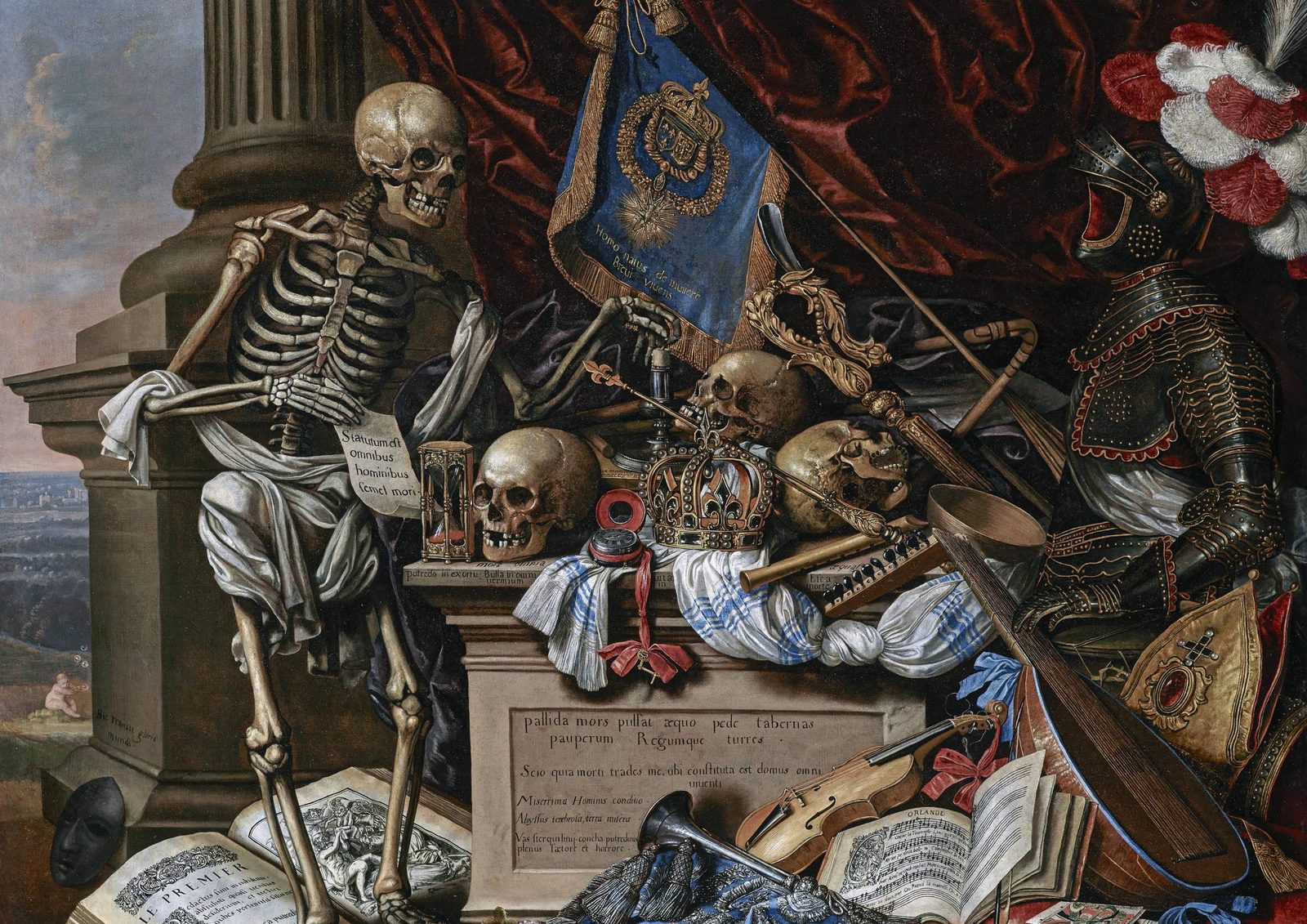
Carstian Luyckx was a Flemish still life painter, born in 1623. His painting’s full catalogue title lists its contents: A Vanitas Still Life with Musical Instruments, Sheet Music, Books, a Skeleton, Skulls, and Armor. A crown, a suit of armour, a lute, a violin and open books crowd the scene. Among them sits a skeleton holding a sheet of parchment, as if waiting for you to read it.
This is the vanitas at full volume. Where Champaigne used three objects, Luyckx used everything, and the message lands the same way. The original belongs to the Sarah Campbell Blaffer Foundation and hangs at the Museum of Fine Arts, Houston.
Vanitas Still Life with a Skeleton is available as a fine art print at The Dark Academia Store.
8. Death on the Pale Horse by Gustave Doré (1866)
The same verse Ryder painted, cut into wood decades earlier.
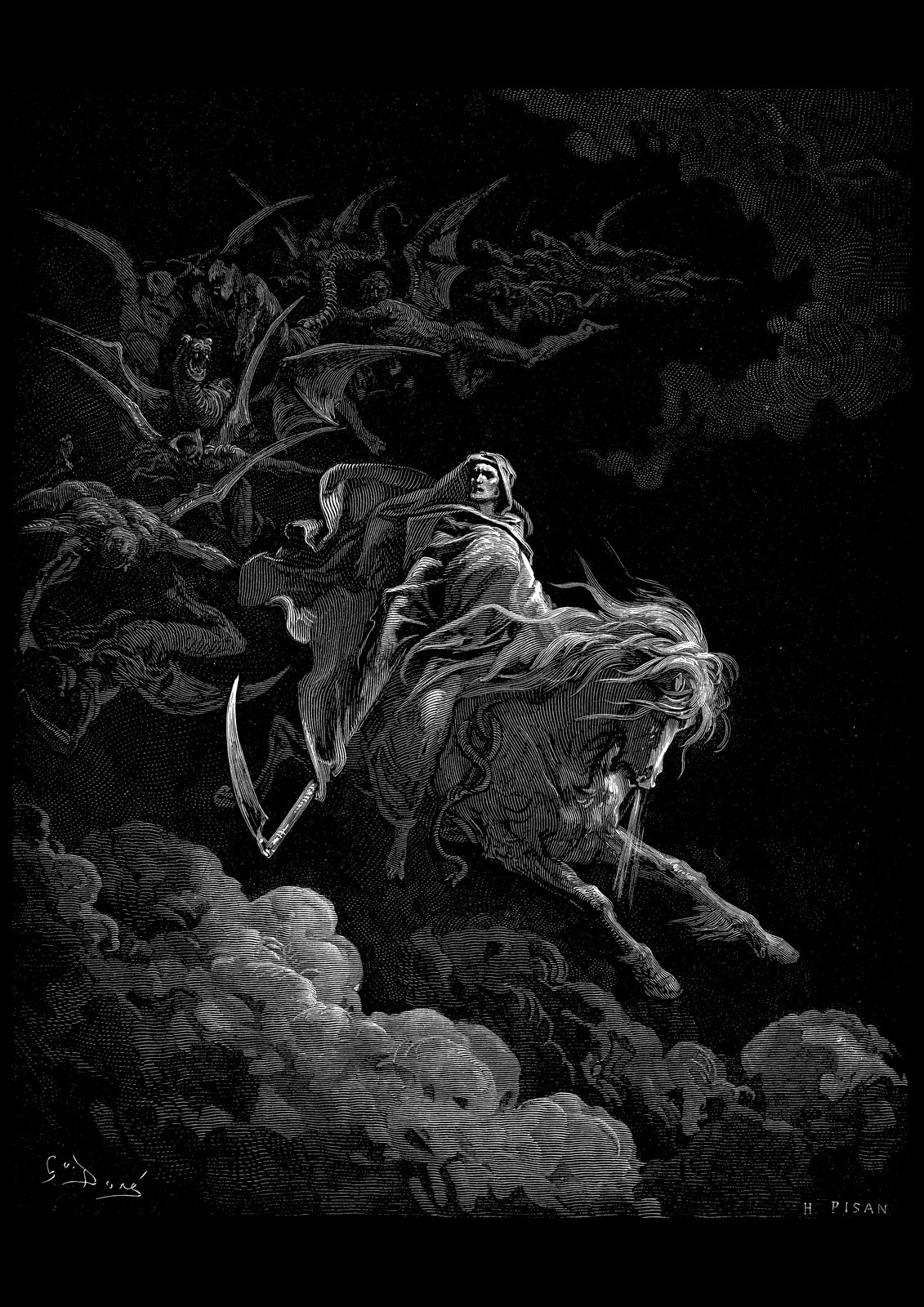
In 1866 Gustave Doré illustrated La Grande Bible de Tours with hundreds of wood engravings. For Revelation 6:8, the opening of the fourth seal, he drew Death on his pale horse, with Hades close behind, riding out to claim a quarter of the earth.
Ryder’s rider circles an empty track in silence. Doré’s charges across the sky with the full force of scripture. Hang the two together and you see how one line of the Bible gave two artists two very different nightmares.
Death on the Pale Horse is available as a fine art print at The Dark Academia Store.
9. Still Life with Books by Jan Lievens (about 1627 to 1628)
For years this painting carried Rembrandt’s name.
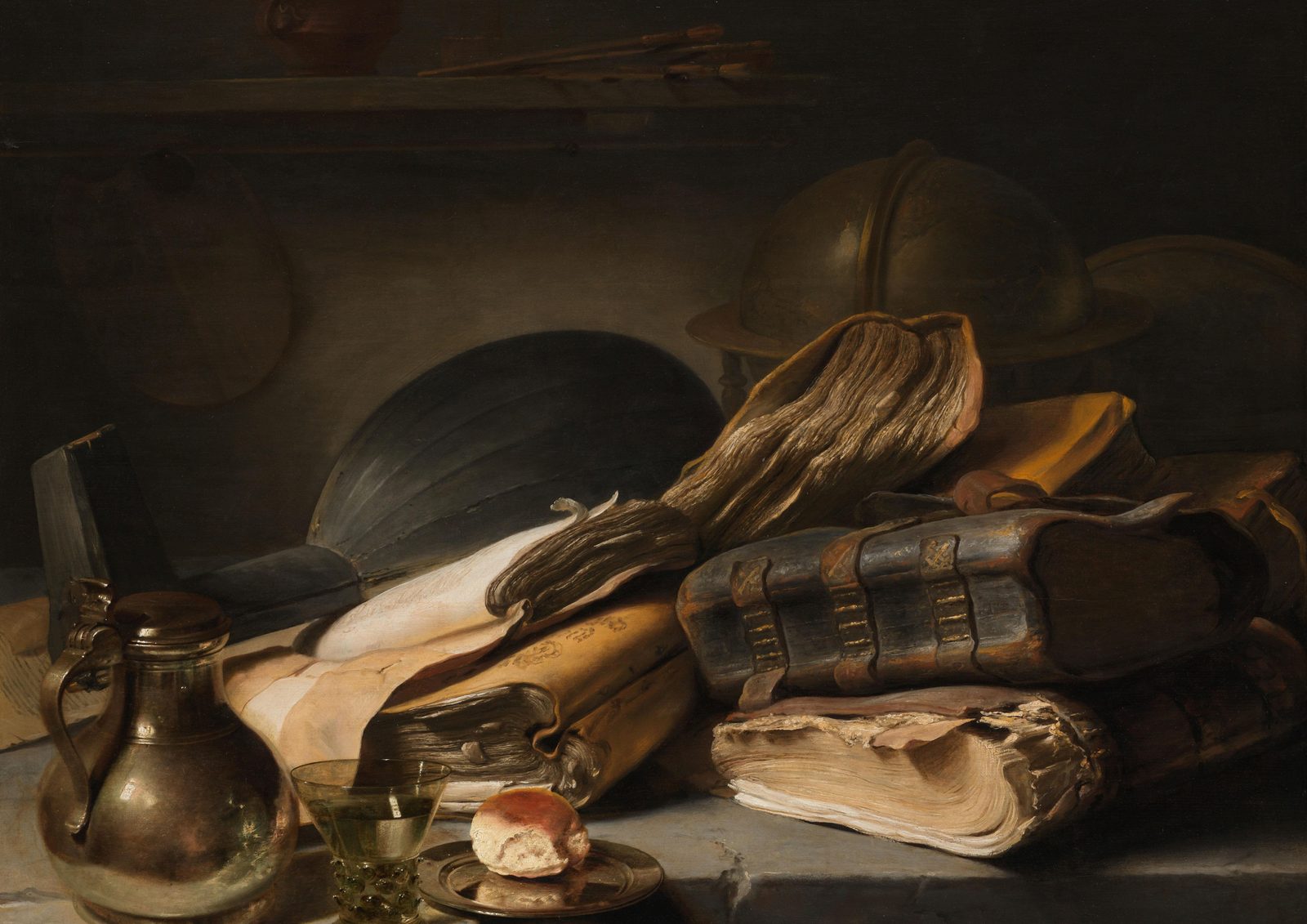
Jan Lievens and the young Rembrandt shared a studio, and experts long credited this still life to Rembrandt. Most now give it to Lievens. Worn ledgers pile up at the back. In front sit a pewter jug, a glass, a bread roll, two globes, a palette and a lute case.
There is no skull and no hourglass, so scholars still argue over its meaning. Some read the battered books as a vanitas about worldly learning, set against the fresh bread and wine. X-rays show the jug was painted over an unfinished book. The original, oil on panel and more than a metre wide, hangs in the Rijksmuseum in Amsterdam.
Still Life with Books is available as a fine art print at The Dark Academia Store.
How to hang memento mori art at home
A memento mori belongs where you think, read or dress for the day.

- Study or home library: hang Memento Mori, “To This Favour” above the desk, or Still Life with Books between the shelves. Both echo the room. An oak frame suits the warm browns.
- Dressing room or beside a mirror: hang Allegory of Death and Death and Life Contrasted as a pair. Each is a mirror of its own, so the joke lands every morning.
- Hallway: The Race Track and Doré’s Death on the Pale Horse side by side in black frames, at A2 or 18x24 inches. Two riders, one verse.
- Dining room: Vanitas Still Life with a Skeleton above a sideboard at A2 or 18x24 inches. Its crowded table rewards a close look.
- Bedroom or reading nook: The Garden of Death is gentle enough to live with. Pair it with Still Life with Flowers in a Glass Vase by Jan Davidsz de Heem, since cut flowers were a vanitas symbol in their own right.
- Over a bar cart: Van Gogh’s Head of a Skeleton with a Burning Cigarette. Small frame, A4 or 12x16 inches, and a dark sense of humour.
- An October gallery wall: group The Race Track with Goya’s Witches’ Sabbath, Witches’ Flight and Pénot’s The Bat Woman. All four hang in The Dark Academia Store.
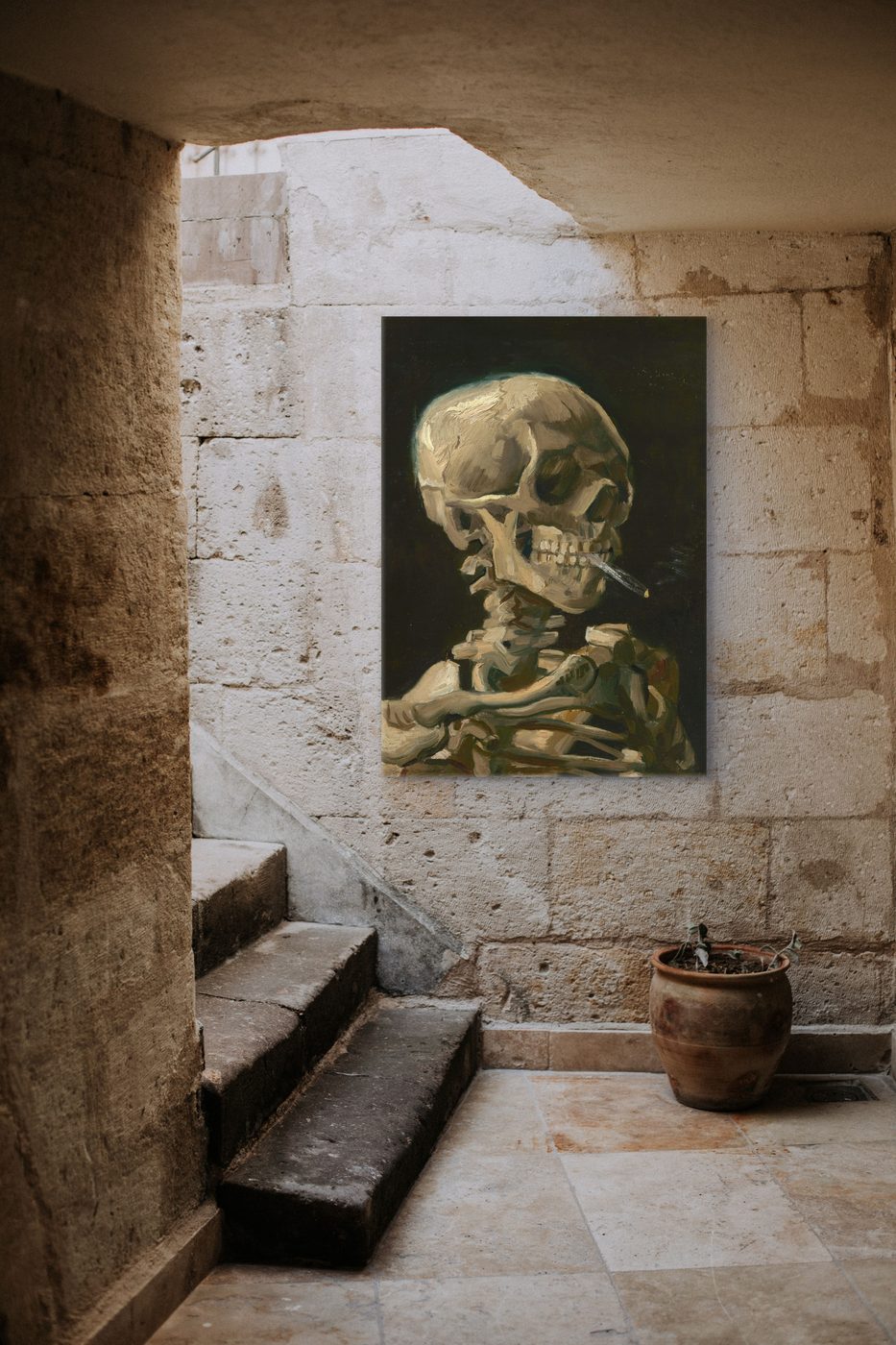
For size, choose A4 or 12x16 inches above a desk, and A2 or 18x24 inches above a fireplace or sideboard. See the print size guide for every size in centimetres and inches.
Memento mori art: frequently asked questions
What does memento mori mean?
Memento mori is Latin for “remember you must die”. In art, it names any work designed to remind the viewer of their own mortality, usually through skulls, hourglasses and snuffed candles.
What is the difference between vanitas and memento mori?
Vanitas is a type of memento mori. A vanitas is a still life of symbolic objects showing how worldly riches and pleasures fade before death. Memento mori is the wider theme and includes portraits, allegories, sculpture and jewellery.
What are the most common memento mori symbols?
The skull is the best known. Others include hourglasses and clocks for passing time, extinguished candles for a life put out, and fruit or cut flowers, which spoil and wilt.
Where to see memento mori art in London?
The National Gallery holds two of the most famous examples: Holbein’s The Ambassadors and Steenwyck’s Still Life: An Allegory of the Vanities of Human Life. Entry to the collection is free.
Is memento mori art depressing?
Most memento mori art aims at the opposite. By reminding you life is short, it pushes you to spend your time well. The National Gallery reads Steenwyck’s still life as a prompt to use time wisely and enjoy the beauty around you.
A last word
A skull on the wall is an old and honest companion. It does not nag. It waits, and every so often it asks whether today was worth it.
If one of these paintings has asked you the question, all nine are waiting as fine art reproductions in the Gothic and Memento Mori collection at The Dark Academia Store on Etsy, printed locally and sent with free tracked shipping.